

 Articles
Voice Over Home Recording Studio
Equipment, vocal booth, skills and a comparison with commercial studios
What exactly is a voice over home recording studio?
A voice over home recording studio — as the name suggests — is a dedicated recording space, set up at home but engineered to produce broadcast-quality audio. In our case, it has been specifically designed for remote collaboration with all key stakeholders in an audiovisual production chain: agencies, film producers, directors, sound engineers, broadcasters, and fellow voice actors.
In this article, we take you on a detailed tour of Fred's studio, walking you through his equipment and outlining the essential components of a professional home recording setup for voice over work.
Voice over home recording studio
A professional home recording studio dedicated to voice over is far more than a room fitted with a microphone and surrounded by foam panels.
It can include:
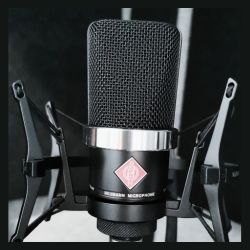
- One or more large-diaphragm condenser microphones (as opposed to dynamic mics), fitted with pop filters to prevent plosives
- An audio interface (also referred to as a sound card)
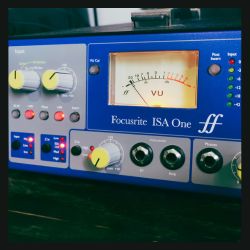
- Optionally, a preamplifier to boost the signal, shape tonal character or improve dynamic response
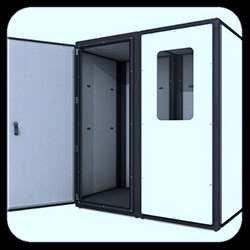
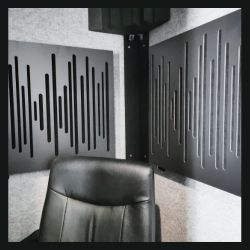
- Acoustic treatment and/or a soundproofed vocal booth with full acoustic treatment, to control reflections and minimise background noise and noise floor
- A reliable, quiet PC or Mac with sufficient RAM, fast SSD drives, and ideally positioned away from the microphone to avoid fan noise contamination
- Professional DAW (Digital Audio Workstation) software for recording and audio editing — Pro Tools, Adobe Audition, Cubase, Reaper, Logic Pro, Studio One… to name but a few
- Communication software (Zoom, Microsoft Teams)
- Browser-based or dedicated software solutions operating over high-speed internet connections, enabling live remote voice direction: Session Link and Source Connect are the industry standards
Fred's studio — an overview
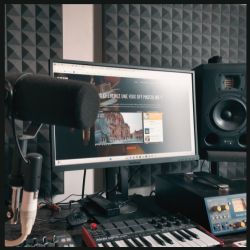
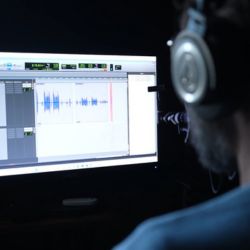
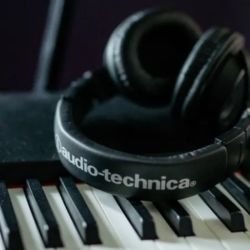
Dry reference recording captured in the vocal booth
Below is a reference sample captured in the vocal booth — completely raw, with no software processing applied, only a high-pass filter (HPF) engaged on the preamplifier.
Raw recording — Vicoustic vocal booth, Neumann TLM 102 condenser microphone, Focusrite ISA One preamplifier
Home recording studio — voice over equipment breakdown
| Les Voix de Fred — studio equipment | Details |
|---|---|
| Vicoustic 'Vicbooth Ultra' vocal booth The booth features full acoustic treatment, achieving over 30 dB of external noise attenuation and a noise floor of -75 dB. 1. Foam panels & absorbers: absorb sound energy, reducing reverb and echo 2. Diffusers: scatter reflections to create an even, controlled acoustic environment 3. Bass traps: absorb low-frequency build-up Watch the unboxing and assembly of the vocal booth below: |
|
| Microphones | 1. Neumann TLM 102 — the go-to condenser mic for virtually any voice over context 2. CAD Equitek E100S, MXL 990 — backup solutions 3. Shure SM7B — for podcasts, conversational recordings and specific projects |
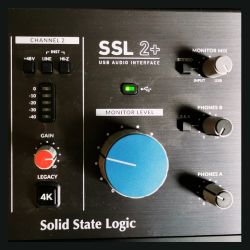
| Audio interfaces | 1. SSL 2+ with Loopback function — ideal for facilitating communication during remotely directed sessions 2. Backup: Audient EVO4 |
| Preamplifier | Focusrite ISA One — a tonally neutral character, an industry reference, and compatible with any microphone |
| Monitoring headphones | 1. Audio-Technica ATH-M50X 2. Beyerdynamic DT 770 Pro 250Ω — the gold standard for voice over monitoring |
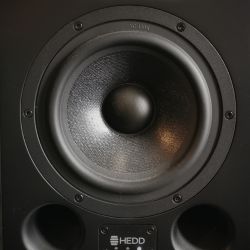
| Studio monitors | 1. HEDD Type 07 MK2 — oversized for voice over alone, but equally suited to mixing and mastering applications 2. PreSonus Eris Studio 5 — well-suited to voice over sessions, with low listening fatigue during long editing sessions |
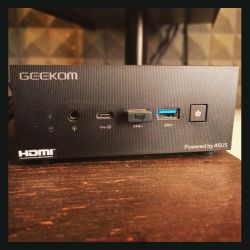
| Workstation | Geekom Ryzen 7, 32 GB RAM — ultra-quiet and powerful |
Skills required to build and run a voice over home studio
The heart of a voice over home recording studio goes well beyond the equipment.
Beyond the voice actor's own artistry, technique and expertise — and unless they have the luxury of working with a dedicated sound engineer — the home studio voice over artist must wear two hats: that of the performer and that of the technician.
For the installation side of the setup listed above, the internet is fortunately rich in guidance to help you choose your equipment according to your budget and creative goals.
For acoustic isolation and treatment, things get more nuanced: ideally, building a professional recording environment should be overseen by a professional — specifically a sound engineer or acoustician who can handle the technical specifications and carry out the necessary acoustic measurements.
Familiarising yourself with audio recording and editing is of course essential. Here again, online resources are plentiful — though dedicated training will always give you a solid technical foundation and help you progress with greater confidence and speed.
Frédéric Blindt has trained extensively in sound recording and mixing techniques, and is fully equipped to handle not only voice over recording, but also audio/video editing and post-production for your audiovisual projects.
Work with a voice actor who operates a professional home recording studio!
'Home studio' vs 'professional home studio' — how to tell the difference?
A professional home studio will deliver:
- 1. Optimal audio quality
A professional home recording studio is built with appropriate acoustic treatment that meets industry norms and standards, guaranteeing clean, broadcast-ready voice over recordings — free from unwanted reverb, background noise and ambient interference, with well-balanced EQ.
In such a setup, the microphone is able to faithfully capture every nuance of the voice actor's performance for a polished, studio-grade result. - 2. Flexibility and convenience
Having a professional home studio means the ability to work at your own pace, at any time of day — and with genuine enjoyment!
Voice over recording very often arrives at the tail end of a production chain, and turnaround deadlines can be extremely tight. Working with a home studio voice actor can therefore be a real productivity solution for certain clients.
That said, it is worth verifying the talent's turnaround times, their retake policy, and — if required — their technical setup for remotely directed sessions. - 3. Improved communication and workflow
Beyond the time saved on a tight production schedule, a home studio voice actor can liaise with you ahead of the project to provide demos or test recordings.
Moreover, should the project require additional takes or amendments at a later stage, you can reach them quickly — and count on consistent, matching audio quality throughout.
Voice over rates for home studio sessions
For rates applicable to home studio or commercial studio sessions, please refer to this ARTICLE.
Conclusion
At a time when remote working has become increasingly prevalent across virtually every industry, the voice over sector is no exception.
That said, recording in a traditional commercial studio with a director and sound engineer who know their craft inside out still offers an unmatched environment — delivering exemplary results with the added comfort of on-site facilities for both the client and the voice talent.
With technology and usage patterns in constant evolution, the challenge is to meet every need: delivering uncompromising audio quality alongside an efficient and reliable remote communication infrastructure.
Resources & further reading
This concludes the article. We hope it has answered your questions about remote voice over recording and the expected standards of a professional home recording studio for voice over work.